

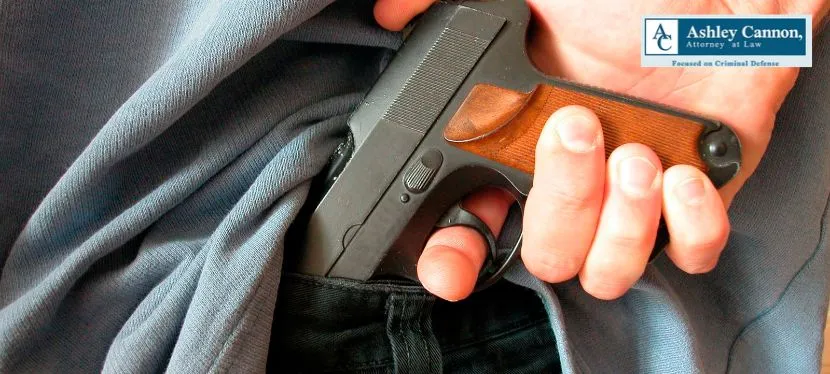

Police found a gun, and because of an old felony, you’re now facing a new one. In North Carolina, having a firearm after a felony conviction is a Class G felony under N.C. Gen. Stat. § 14-415.1, and you could face prison time. But a gun under a passenger seat or in a shared closet? Not automatically yours. The State has to prove you knew it was there and could control it.
Since December 1, 2025, possession of a firearm by a felon in North Carolina can climb as high as a Class C felony, depending on what else prosecutors say happened. Proving control is often harder than it sounds, though, and what you do this week can change how this case ends.
Ashley Cannon, Attorney at Law, defends gun charges in Statesville and across Iredell County. Ms. Cannon spent four years as an assistant district attorney before switching sides, so she knows how these cases get built.
Key Takeaways
- A standard felon in possession conviction is a Class G felony with a presumptive minimum of 10 to 13 months at the lowest record level. Since December 1, 2025, it can rise to a Class F, D, or C felony when prosecutors tie the gun to another felony.
- The gun doesn’t have to be yours or in your hand, but the State still has to prove you controlled it.
- Prosecutors must prove your old conviction in detail, and errors in the indictment can sink the case.
- Anything you tell police about the gun can be used against you, and a single admission that you knew it was there can give prosecutors the proof of control they need.
Before you talk to investigators, talk to a defense lawyer. Call Ashley Cannon, Attorney at Law, any time, day or night, about gun charges in Iredell County.
What Counts as Possession of a Firearm by a Felon in North Carolina?
Anyone with a felony on their record who buys, owns, possesses, or controls a firearm commits this crime under N.C. Gen. Stat. § 14-415.1, and the age of the conviction doesn’t matter.
The key word is possession, which can be actual or constructive. Actual means the gun is on you. Constructive means it was somewhere you had the power and intent to control, like a glove box. So even if the gun belongs to someone else, you can still be convicted if the State can prove you controlled it.
Felon in Possession Penalties in North Carolina for 2026
Your sentence depends on the offense class and your prior record level, matched on the state’s felony punishment chart under N.C. Gen. Stat. § 15A-1340.17.
The Base Charge: Class G Felony
At Prior Record Level I, the presumptive minimum for a Class G felony is 10 to 13 months. The North Carolina Sentencing and Policy Advisory Commission lists the top sentence for a Class G felony at 47 months.
The December 2025 Upgrades
Since December 1, 2025, the charge gets more serious when the gun is tied to another felony, according to the legislature’s summary of the new law.
There are three new levels:
- Having the gun while committing most state felonies, including drug felonies, is a Class F felony.
- Brandishing it during that felony, even just letting someone know it’s there, is a Class D felony.
- Firing it during that felony is a Class C felony, with a presumptive minimum of 58 to 73 months at the lowest record level.
The UNC School of Government compares these levels to a federal law that adds prison time for guns used in crimes.
The Federal Risk
The U.S. Attorney’s Office for the Western District of North Carolina, which covers Statesville, can prosecute the same conduct under federal law. There, the maximum is usually 15 years, or longer with certain prior records, and there’s no parole. Sorting out which version you face is the first job for a felon in possession of a firearm attorney, and Ashley Cannon, Attorney at Law, can review the charging papers before the first court date.
The Old Conviction Is Part of This Case
The State has to prove your old conviction like any other part of the case. It needs a separate indictment that spells out when the earlier crime happened, what punishment it carried, and which court convicted you. A conviction from another state only counts if it matches a North Carolina felony and could have carried more than a year in prison. Mistakes in that paperwork happen, so pull the old file early.
Defenses to a Felon in Possession of a Firearm Charge
Most defenses come down to four questions:
- Was the gun under your control?
- Did police find it legally?
- Does your old conviction still count?
- Did you have the gun to protect someone’s life?
Each one can work in your favor like this:
- The gun wasn’t under your control: being near a gun isn’t enough. When you share a car or home, prosecutors need more evidence tying you to it, like your fingerprints on it or your mail next to it.
- Police found it illegally: if the stop or search broke the law, a judge can throw the gun out as evidence. Ms. Cannon won that kind of ruling at the North Carolina Court of Appeals in State v. Knudsen, 229 N.C. App. 271 (2013).
- Your conviction doesn’t count: the law doesn’t apply after a pardon or once your firearms rights are restored, and certain antitrust and unfair-trade convictions never count.
- You had the gun to protect a life: North Carolina courts allow a narrow defense when someone picks up a gun to escape an immediate threat of death or serious injury to themselves or others.
These defenses often depend on proof that can fade quickly. Body camera video can show whether the search was legal, and witnesses or lease records can show who else had access to the car or home. An attorney handling a felon in possession of a firearm case should gather that proof within days of the arrest, before any plea offer is made.
Frequently Asked Questions
Can a felon get gun rights back in North Carolina?
Sometimes, but only after a long wait. Under N.C. Gen. Stat. § 14-415.4, a person with one nonviolent felony can petition the district court once their civil rights have been restored for at least 20 years. That’s worth looking into if this case ends without a new felony conviction, especially if you hunt or want to protect your family.
Should I talk to the detective about the gun?
No, not before you speak with a lawyer. The Fifth Amendment lets you refuse to answer questions, and a single admission that you knew the gun was there can hand prosecutors the proof of control they’re missing. Say politely that you want a lawyer, then stop talking.
Can I get probation for a felon in possession charge?
It depends on your record. Through Level IV, a judge can choose probation with stricter conditions instead of prison. At Levels V and VI, the law requires prison time.
What happens if I was on probation when the gun was found?
You’ll likely face two cases at once: the new gun charge and a probation violation hearing in your old case. A new criminal offense is one of the few violations that lets a judge revoke probation and activate your original sentence, and the judge doesn’t have to wait for a conviction to do it. That hearing often comes first, so it needs a plan from day one.
Ashley Cannon, Attorney at Law: Your Gun Crime Law Firm
A felon in possession charge is frightening, especially when an old conviction you’d put behind you is suddenly the center of a new case. Ms. Cannon has read these files from the prosecutor’s side, so she starts where the State starts, with the prior judgment, the search, and who had access to that gun.
Small gaps in those three places decide a lot of felon in possession cases in Iredell County (and the window to find them closes once footage gets overwritten).
Contact our firm today to talk through the charge, and you’ll get a straight read on where things stand.